Photos from previous classroom observing sessions
These photos were taken by Paul Klauninger using Carleton's very own telescope during special observing sessions with students. Many thanks to Paul for showing us the magic of astrophotography and for sharing his passion for astronomy.
 |
M27 |
 |
M15 |
 |
M31 |
 |
Jupiterhttp://solarsystem.nasa.gov/planets/profile.cfm?Object=Jupiter |
 |
M31 |
 |
M81 and M82 http://www.universetoday.com/24388/in-depth-observing-m81-and-m82 |
 |
Globular Cluster M2This is a picture of the globular cluster M2 (NGC 7089) which is in the constellation Aquarius. It was discovered by Jean-Dominique Maraldi in 1746 while observing a comet with Jacques Cassini. In 1783, William Herschel first to resolved M2 to reveal individual stars in the cluster. Located 37.500 light years from Earth and situated in the galactic halo, M2 contains approximately 150,000 stars. Globular clusters consist of some of the oldest stars in the galaxy. [Photo by Graham Cree.] |
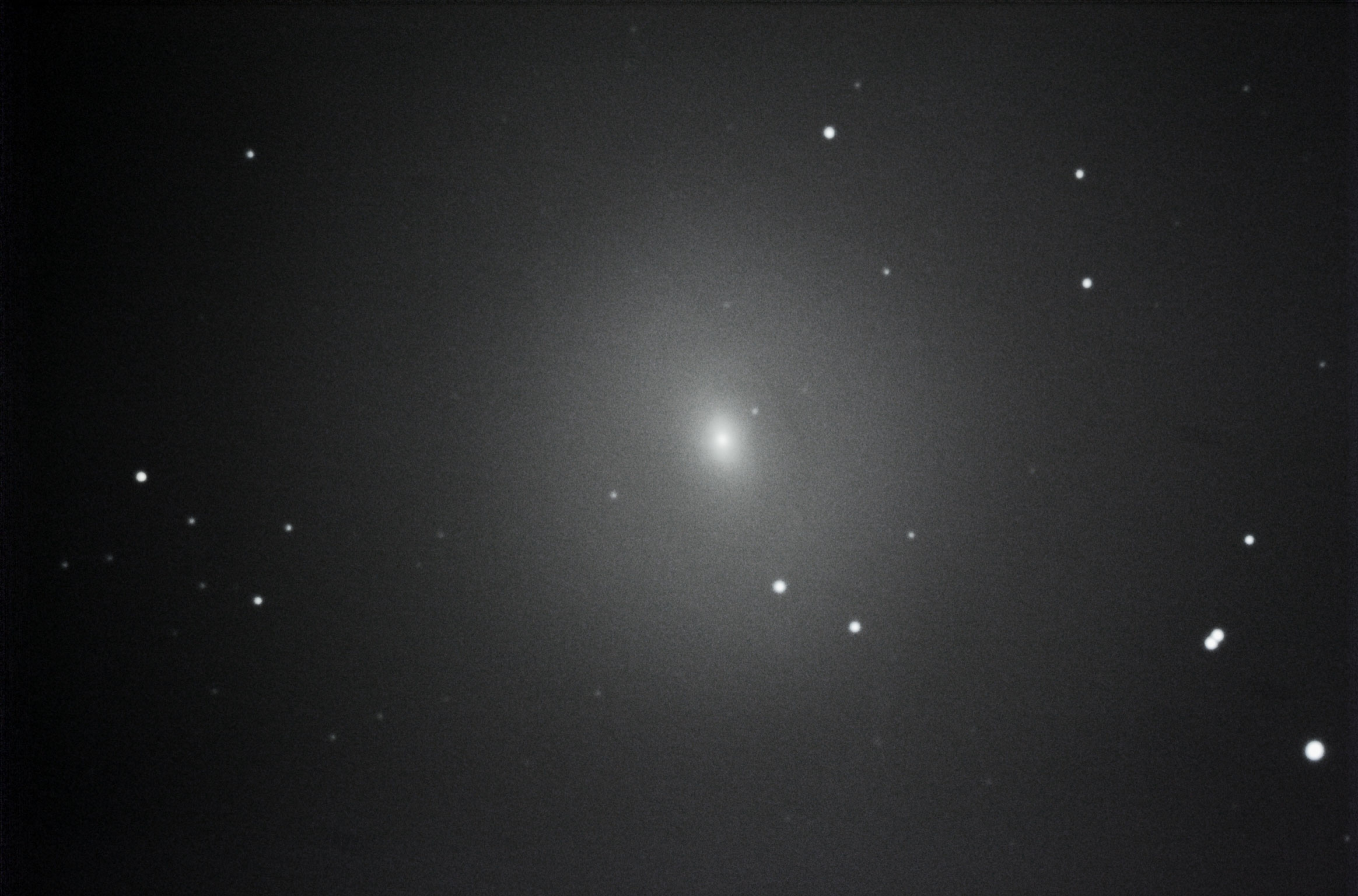 |
Spiral Galaxy M81This is a picture of the M81. Situated in the constellation Ursa Major, M81 (also known as NGC 3031 or Bode's Galaxy) is a spiral galaxy about 12 million light-years from our solar system. Johann Elert Bode discovered M81 in 1774 and in 1779 Charles Messier added it to the Messier Catalogue. [Photo by Graham Cree.] |
 |
JupiterThis an image of Jupiter at its four largest moons, Io, Europa, Callisto, and Ganymede, taken on October 3rd during an after class observing session. In 1610, Galileo discovered the four largest moons of Jupiter now collectively called the Galilean satellites. Galileo's discovery was the first observation of a celestial motion not apparently centered on the Earth. Arguing in favour of Copernicus' heliocentric theory of the motions of the planets, Galileo ran afoul of the Catholic Church leading to condemnation and house arrest for the rest of his life. [Photo by Graham Cree.] |
 |
Globular Cluster M3This is a picture of M3 that we took on May 27, 2008. M3 is a spectacular example of a globular cluster, first catalogued by French astronomer Charles Messier in 1764. Located 33,900 light years from earth and situated in the galactic halo, M3 contains approximately 500,000 stars. Globular clusters consist of some of the oldest stars in the galaxy. In 1784, British astronomer William Herschel first resolved M3 into its constituent stars. |
 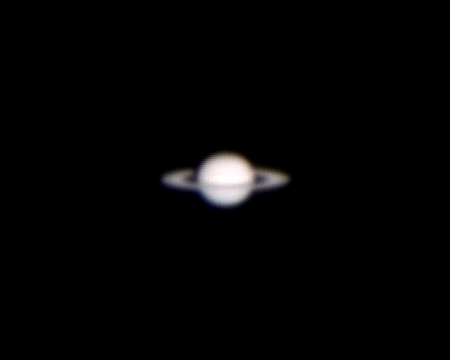 |
SaturnThese are pictures of Saturn that we took on May 29, 2008. The most distant planet known to the ancient world, in 1610 Galileo discovered that Saturn had "ears". In 1655 Christiaan Huygens, resolved the "ears" of Saturn into rings. Saturn's beautiful ring system is composed largely of ice particles that range from dust sized pebbles to boulders as large as a house. At only a few tens of metres thick, the rings extend over 100,000 km above the atmosphere of Saturn. |
 |
Galaxy M82This is a picture of M82 that we took on May 29, 2008. M82 is an example of an irregular galaxy, although astronomers now think that M82 might be a distorted disk galaxy. Located in the constellation Ursa Major (the big dipper), M82 sits 12 million light years from our galaxy. Recently, astronomers have detected rich star forming regions using the Hubble Space Telescope. Discovered in 1774 by Johann Elbert Bode, Charles Messier added M82 to his catalog in 1781. |